H-theorem

|
This article is a 'stub' page, it has no, or next to no, content. It is here at the moment to help form part of the structure of SklogWiki. If you add sufficient material to this article then please remove the {{Stub-general}} template from this page. |
Boltzmann's H-theorem
Boltzmann's H-theorem states that the entropy of a closed system can only increase in the course of time, and must approach a limit as time tends to infinity.

where is the entropy source strength, given by (Eq 36 Chap IX Ref. 2)

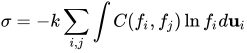
where the function C() represents binary collisions. At equilibrium, .

Boltzmann's H-function
Boltzmann's H-function is defined by (Eq. 5.66 Ref. 3):
- Failed to parse (Conversion error. Server ("https://wikimedia.org/api/rest_") reported: "Cannot get mml. Server problem."): {\displaystyle H=\iint f({\mathbf {V} },{\mathbf {r} },t)\ln f({\mathbf {V} },{\mathbf {r} },t)~d{\mathbf {r} }d{\mathbf {V} }}
where is the molecular velocity. A restatement of the H-theorem is

- Failed to parse (Conversion error. Server ("https://wikimedia.org/api/rest_") reported: "Cannot get mml. Server problem."): {\displaystyle {\frac {dH}{dt}}\leq 0}
Gibbs's H-function
See also
References
- L. Boltzmann "", Wiener Ber. 63 pp. 275- (1872)
- Sybren R. De Groot and Peter Mazur "Non-Equilibrium Thermodynamics", Dover Publications
- Robert Zwanzig "Nonequilibrium Statistical Mechanics", Oxford University Press (2001)
Related reading