Monte Carlo in the microcanonical ensemble
Integration of the kinetic degrees of freedom
Consider a system of identical particles, with total energy given by:


- ; (Eq.1)
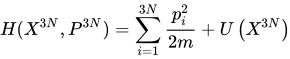
where:
- Failed to parse (Conversion error. Server ("https://wikimedia.org/api/rest_") reported: "Cannot get mml. Server problem."): {\displaystyle \left.X^{3N}\right.} represents the 3N Cartesian position coordinates of the particles
- stands for the the 3N momenta.

The first term on the right hand side of (Eq. 1) is the kinetic energy, whereas the second term is
the potential energy (a function of the positional coordinates).
Now, let us consider the system in a microcanonical ensemble; let be the total energy of the system (constrained in this ensemble).

The probability, of a given position configuration Failed to parse (Conversion error. Server ("https://wikimedia.org/api/rest_") reported: "Cannot get mml. Server problem."): {\displaystyle \left.X^{3N}\right.} , with potential energy can be written as:


- Failed to parse (Conversion error. Server ("https://wikimedia.org/api/rest_") reported: "Cannot get mml. Server problem."): {\displaystyle \Pi \left(X^{3N}|E\right)\propto \int dP^{3N}\delta \left[K(P^{3N})-\Delta E\right]} ; (Eq. 2)
where:
- is the Dirac's delta function

- .

The Integral in the right hand side of (Eq. 2) corresponds to the surface of a 3N-dimensional () hyper-sphere of radius Failed to parse (Conversion error. Server ("https://wikimedia.org/api/rest_") reported: "Cannot get mml. Server problem."): {\displaystyle r=\left.{\sqrt {2m\Delta E}}\right.} ; therefore:

- Failed to parse (Conversion error. Server ("https://wikimedia.org/api/rest_") reported: "Cannot get mml. Server problem."): {\displaystyle \Pi \left(X^{3N}|E\right)\propto \left[E-U(X^{3N})\right]^{(3N-1)/2}} .
See Ref. 1 for an application of Monte Carlo simulation using this ensemble.