Stirling's approximation
James Stirling (1692-1770, Scotland)

Because of Euler-MacLaurin formula
- Failed to parse (Conversion error. Server ("https://wikimedia.org/api/rest_") reported: "Cannot get mml. Server problem."): {\displaystyle \sum _{k=1}^{N}\ln k=\int _{1}^{N}\ln x\,dx+\sum _{k=1}^{p}{\frac {B_{2k}}{2k(2k-1)}}\left({\frac {1}{n^{2k-1}}}-1\right)+R,}
where B1 = −1/2, B2 = 1/6, B3 = 0, B4 = −1/30, B5 = 0, B6 = 1/42, B7 = 0, B8 = −1/30, ... are the Bernoulli numbers, and R is an error term which is normally small for suitable values of p.
Then, for large N,

after some further manipulation one arrives at
- Failed to parse (Conversion error. Server ("https://wikimedia.org/api/rest_") reported: "Cannot get mml. Server problem."): {\displaystyle N!={\sqrt {2\pi N}}\;N^{N}e^{-N}e^{\lambda _{N}}}
where
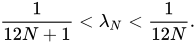
For example:
| N | N! (exact) | N! (Stirling) | Error (%) |
| 5 | 120 | 118.019168 | 1.016 |
| 6 | 720 | 710.078185 | 1.014 |
| 7 | 5040 | 4980.39583 | 1.012 |
| 8 | 40320 | 39902.3955 | 1.010 |
| 9 | 362880 | 359536.873 | 1.009 |
| 10 | 3628800 | 3598695.62 | 1.008 |
As one usually deals with number of the order of the Avogadro constant () this formula is essentially exact.
