Kumari-Dass equation of state
Kumari and Dass[1][2] presented a model based on a linear bulk modulus equation, in the spirit of the Murnaghan equation of state. The equation of state does not correctly model the bulk modulus as the pressure, , tends towards infinity, as it remains bounded. This is apparent in the equation relating the bulk modulus to pressure:

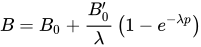
where Failed to parse (SVG (MathML can be enabled via browser plugin): Invalid response ("Math extension cannot connect to Restbase.") from server "https://wikimedia.org/api/rest_v1/":): {\displaystyle B_0} is the isothermal bulk modulus, Failed to parse (SVG (MathML can be enabled via browser plugin): Invalid response ("Math extension cannot connect to Restbase.") from server "https://wikimedia.org/api/rest_v1/":): {\displaystyle B_0'} is the pressure derivative of the bulk modulus and Failed to parse (SVG (MathML can be enabled via browser plugin): Invalid response ("Math extension cannot connect to Restbase.") from server "https://wikimedia.org/api/rest_v1/":): {\displaystyle \lambda} is a softening parameter for the bulk modulus. This leads to a equation for pressure dependent on these parameters of the form:
- Failed to parse (SVG (MathML can be enabled via browser plugin): Invalid response ("Math extension cannot connect to Restbase.") from server "https://wikimedia.org/api/rest_v1/":): {\displaystyle p=\frac{1}{\lambda}\left[\frac{\lambda B_0 \left(V/V_0\right)^{-\lambda B_0 + B_0'}+B_0'}{\lambda B_0 + B_0'}\right]}
References[edit]
- ↑ M. Kumari and N. Dass "An equation of state applied to sodium chloride and caesium chloride at high pressures and high temperatures", Journal of Physics: Condensed Matter 2 pp. 3219-3229 (1009)
- ↑ M. Kumari and N. Dass "An equation of state applied to 50 solids. II", Journal of Physics: Condensed Matter 2 pp. 7891-7895 (1990)